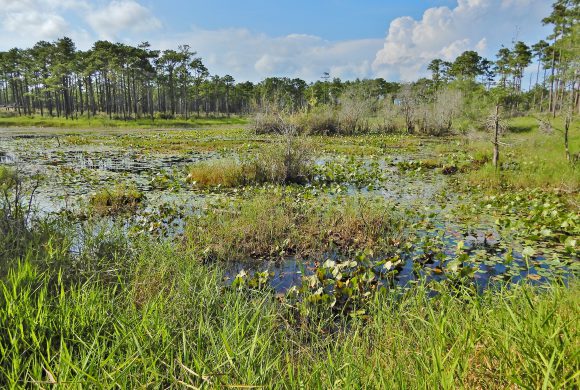
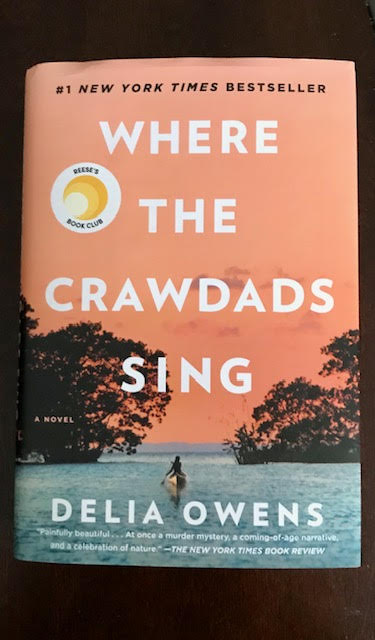
The hidden splendor of coastal North Carolina is the true starring character of Delia Owen’s first novel, Where the Crawdads Sing. With a naturalist’s eye, Owens uses the poetry of fiction to capture the mysterious beauty of the marsh in exquisite detail. The freshwater wetland comes to life through the eyes of its main co-star Kya, who is forced to fend for herself in its vibrant wilderness as a child.
Wholly abandoned by her family, Kya learns to scrabble her way to surviving–and, ultimately, thriving–in the untamed environment. While her knowledge and love of the flora and fauna that surrounds her expands meteorically as she matures into young womanhood, the enigmatic beauty is a much slower study of human nature. When it comes to coexisting with other humans, Kya treads in unfamiliar waters. Generally, she is hesitant to grant others her trust, though, when it comes to romance, her pace proves uneven. When she is not actively front crawling away from human affection, she finds herself nearly drowning in heartbreak, aching solitude, and even physical danger.
The novel opens with riveting and infectious prose, but it eventually meanders and crawls to a sluggish and plodding pace. This is largely due to the fact that this novel suffers from an identity problem: It wants to simultaneously be a romance novel, murder mystery, family drama and definitive work of nature writing. To me, it only truly shines at the latter.
The physical danger Kya gets wrapped up in is what ultimately produced what I felt was the least intriguing aspect of the novel. The murder mystery plot is anemic at best, and all the secondary players read like worn clichés. At its worst, the nature-filled metaphors for entrapment feel far too heavy-handed. Stubbornness more than infectious curiosity that kept me from stopping the novel midway.
While Tate’s abiding love and devotion to Kya and her livelihood were endearing, I found myself not really caring if the two would survive beyond a childhood romance. Perhaps the ‘educated man-as-savior’ trope rubbed me the wrong way. Or it was the way he got a pass, of sorts, after so abruptly and completely disappearing from his love’s life in the first place. I felt that Tate didn’t give a thorough explanation to Kya, and thus, the author didn’t give a real one to the reader either.
Similarly, I felt Kya was almost too forgiving of the family that left her alone to deal with a drunk, abusive father. While I empathized with the internal struggles of certain members of her family, there is no real satisfying explanation as to why no one could bother to take Kya with them when they left. It is no wonder that she has such crippling trust issues or why her first instinct is to run.
Despite these issues, Owen’s mastery of descriptive narration earned by authentic respect and admiration, and I look forward to finally reading her nonfiction nature writing. I felt her novel truly shined in its expert exploration and tender tribute to the majesty of nature, evoking a renewed sense of awe and wonder in me for wildlife. Reading this lit a spark in me to learn more of the world that exists outside the dictated confines of these suburban walls. I am eager to stoke the fire from a casually interested passerby to a fully immersed and knowledgeable observer of nature’s treasured sights and sounds.
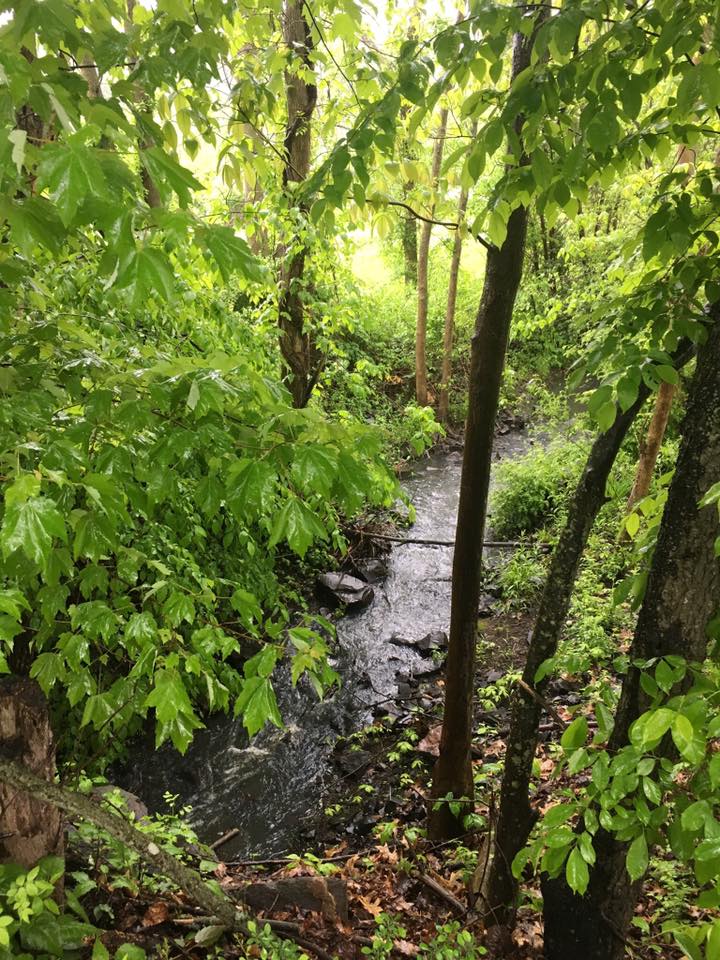
“Do you guys specifically seek out places to live that are near bodies of water,” my friend Melissa asked me as we watched the brook tumbling past the hiking trail we followed in the pouring rain. The trailhead was located across the street from my condo complex. “You always seem to find homes that are close to the water.”
Her question gave me pause, but as I thought more about our last few homes, I realized she had a point. Here, there is the brook that bisects that Mattabesset River, just a couple miles away. At our previous home, a man-built pond lay at the bottom of the hill in our yard. Before that, we were the closet to a beach that I’ve ever lived. And before that, lush flowers filled our yard, giving way to an above-ground, saltwater pool that sat unhindered beneath the sky.
I love the flash of slate blue rippling across craggy rocks. The steady, though meandering flow of moving water becomes my drishti–my point of focus and concentration as I meditate on the lessons of nature:
The river is constantly turning and bending and you never know where it’s going to go and where you’ll wind up. Following the bend in the river and staying on your own path means that you are on the right track. Don’t let anyone deter you from that.
–Eartha Kitt
The ocean–though not necessarily the beach–is one of my happy places as well. My mind is focuses and becomes hypnotized by the ebb and flow of the tide. Peace lies somewhere in the din of the thunder and roar of crashing waves.
if
the ocean
can calm itself,
so can you.
we
are both
salt water
mixed with
air.
― Nayyirah Waheed
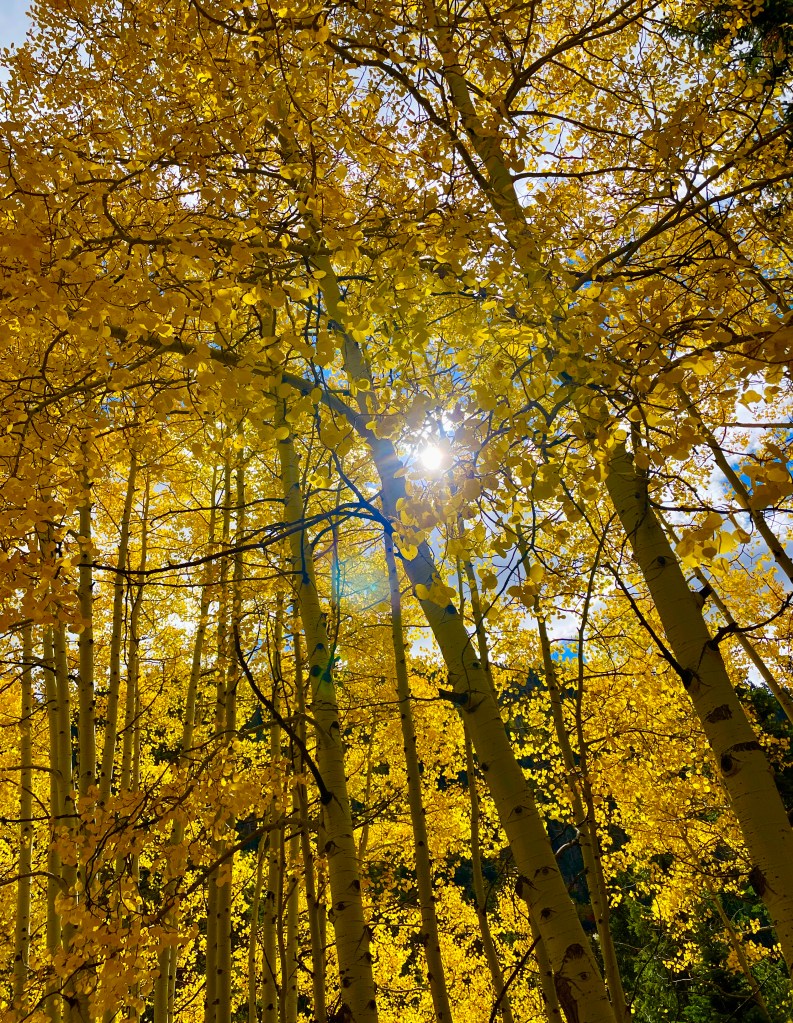
Yet inner peace also can be found by me in the midst of the woods, beneath the protective cover of long-limbed trees and among the leafy plumage of flora. Water purifies, energizes and empowers me, while greenery centers, grounds and replenishes me. Green is quite literally sign of life–of nourishment and vibrancy. I find these things as well when I fully observe and take in the verdant landscape.
I felt my lungs inflate with the onrush of scenery— air, mountains, trees, people. I thought, ‘This is what it is to be happy.’ –Sylvia Plath
I grew up among the hills, surrounded by trees and close neighbors with the fauna. I swallowed the fresh breezes, drawing the oxygen deeply into the lungs, carrying it straight to the heart and then passing through the paper-thin walls of alveoli before slipping into my blood. Now, as an adult, when I’ve spent far too long behind the desk–breathing in the stale air of the indoors for hours on end–stepping across the threshold of front door immediately releases some of the tension. My eyes catch on a furry squirrel leaping from the trees and running across the railing of the back deck, and I regain my sense of curiosity, wonder and awe.
“As long as lush greenery is somewhere close by, I am happy,” I told my friend. “When trees are near, it feels like home.

 “Do you guys specifically seek out places to live that are near bodies of water,” my friend Melissa asked me as we watched the brook tumbling past the hiking trail we followed in the pouring rain. The trailhead was located across the street from my condo complex. “You always seem to find homes that are close to the water.”
 Renée Can(ada) Writes